
Alumnus and Global Health Leader Challenges Pharmacists to Shape Their Own Future
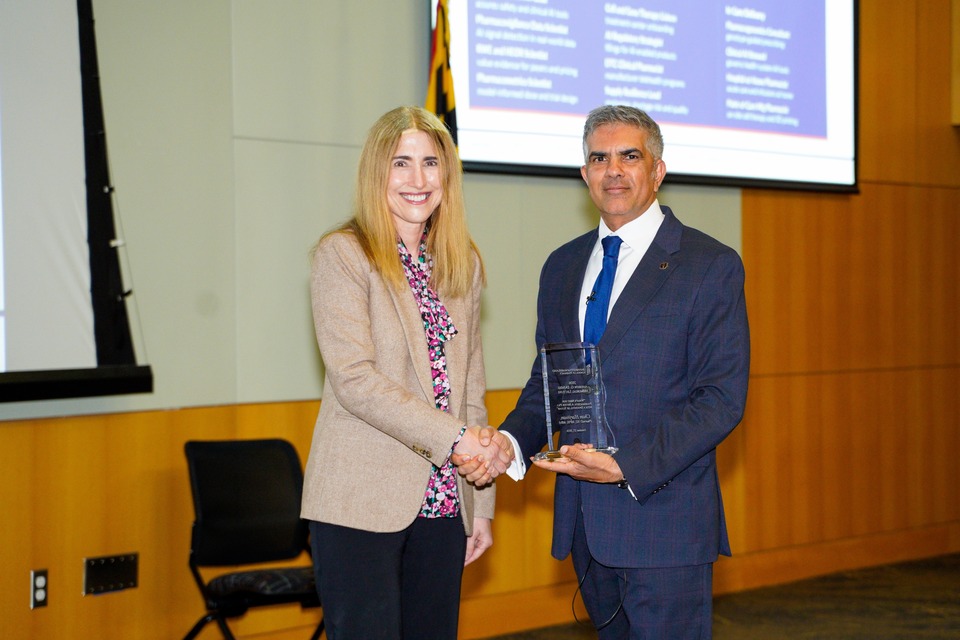
During the annual Andrew G. DuMez Memorial Lecture, Dr. Chan Harjivan shared insights on the challenges and opportunities shaping the future of pharmacy.
By UMSOP Communications and Marketing
November 5, 2026
The future of pharmacy will be defined not by dispensing medications, but by how pharmacists harness technology, expand patient care, and lead innovation across health care and public health systems.
That was the central message delivered by Chan Harjivan, PharmD ’02, MPH, MBA, a distinguished alumnus of the University of Maryland School of Pharmacy, during the 2026 Andrew G. DuMez Memorial Lecture held Oct. 27.
In a thought-provoking presentation titled, “What’s Next for Pharmacists: A Bitter Pill with a Spoonful of Sugar,” Harjivan offered an assessment of the challenges facing the profession while highlighting emerging opportunities for pharmacists to play a greater role in patient care, artificial intelligence, public health, and drug innovation.
“Pharmacy has so many opportunities,” said Harjivan, who earned his PharmD from the School in 2002 before building a career in public health, government, and biopharmaceutical innovation. “Throughout my career, it’s been such an advantage to be a pharmacist.”
During her introduction, Sarah L.J. Michel, PhD, dean of the School and professor of pharmaceutical sciences, described Harjivan as an alumnus whose career has spanned pharmacy practice, global health strategy, public service, and industry leadership. She noted his service in two presidential administrations, including as a special assistant to President Biden, as well as his contributions to Operation Warp Speed during the COVID-19 pandemic.
A Profession at a Crossroads
Drawing on his experience in government, consulting, and global health, Harjivan outlined five major forces reshaping pharmacy: a shrinking retail pharmacy footprint, declining dispensing margins, a weakening talent pipeline, a shift in health care spending toward specialty and clinic-based care, and growing vulnerabilities in pharmaceutical supply chains.
He pointed to widespread pharmacy closures across the United States and increasing pressure from pharmacy benefit managers as evidence that the traditional dispensing-based business model is under strain. Yet he stressed that the profession’s most valuable asset remains unchanged.
“What survives and appreciates is the pharmacist’s clinical judgment, data fluency, and command of the supply chain,” he said.
Harjivan also challenged educators and professional leaders to strengthen pharmacy’s reputation by maintaining high standards, advocating for expanded scope of practice, and ensuring pharmacists are prepared to take on broader clinical and leadership responsibilities.
Throughout the lecture, audience members engaged him in discussion about workforce trends, pharmacy education, reimbursement, and the profession’s future role within interdisciplinary health care teams.
Pharmacists and the AI Revolution
A major focus of the lecture was the rapid emergence of artificial intelligence and its potential to transform health care delivery.
Rather than viewing AI as a threat, Harjivan encouraged pharmacists to become leaders in developing, validating, and governing AI-powered health tools. He predicted that AI systems will increasingly assist with clinical decision-making, patient monitoring, administrative tasks, and drug development, creating new opportunities for pharmacists to apply their expertise.
“I think that’s a huge opportunity,” he said. “Pharmacists can really inject themselves here and add a lot of value to patient care.”
He urged pharmacy schools to build partnerships with leading AI companies and health technology organizations so students can gain firsthand experience with emerging tools and technologies.
According to Harjivan, pharmacists are uniquely positioned to help ensure AI systems are accurate, equitable, and clinically meaningful.
“It’s not just being AI savvy,” he said. “It is building the AI tools, owning the AI tools.”
New Opportunities for Leadership
Looking ahead, Harjivan described a future in which pharmacists assume expanded roles in precision medicine, pharmacogenomics, point-of-care testing, supply chain management, advanced manufacturing, and home-based care. He highlighted emerging career paths ranging from AI model validation and pharmacovigilance to hospital-at-home services and personalized drug manufacturing.
He emphasized that while technology will automate many routine tasks, it cannot replace the clinical judgment and accountability that pharmacists provide.
“The robot replaces the margin, not the pharmacist,” he said, echoing a theme from his presentation.
Ultimately, Harjivan encouraged students, faculty, and practitioners to view the profession’s challenges as an opportunity to redefine pharmacy’s role in health care.
“Drugs are the center of everything,” he told attendees. “How do we make sure that pharmacists are at the top of the loop of every one of those interventions?”
The answer, he suggested, lies in ensuring pharmacists remain at the forefront of innovation, patient care, and the technologies that will shape the future of medicine.
The annual lecture honors Andrew G. DuMez, who served as dean of the University of Maryland School of Pharmacy from 1926 to 1948 and helped establish the institution as a national leader in pharmacy education. During his tenure, he oversaw development of the Pharmacy-Dental Building, advanced graduate education, and served as president of both the American Pharmacists Association and the American Association of Colleges of Pharmacy.
Related News Stories
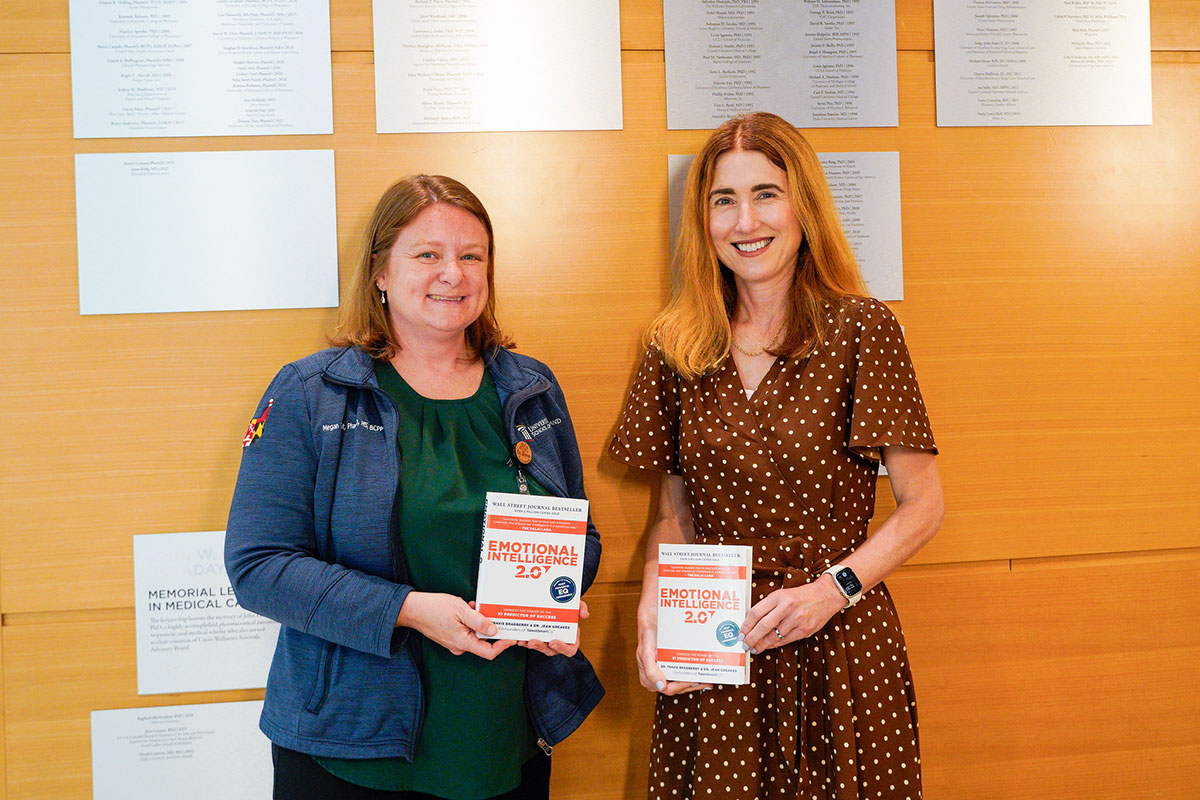
DuMez Memorial Lecture Explores Role of Emotional Intelligence in Leadership and Learning
May 5, 2026
Ehret emphasizes that emotional intelligence shapes how we think, act, and lead.
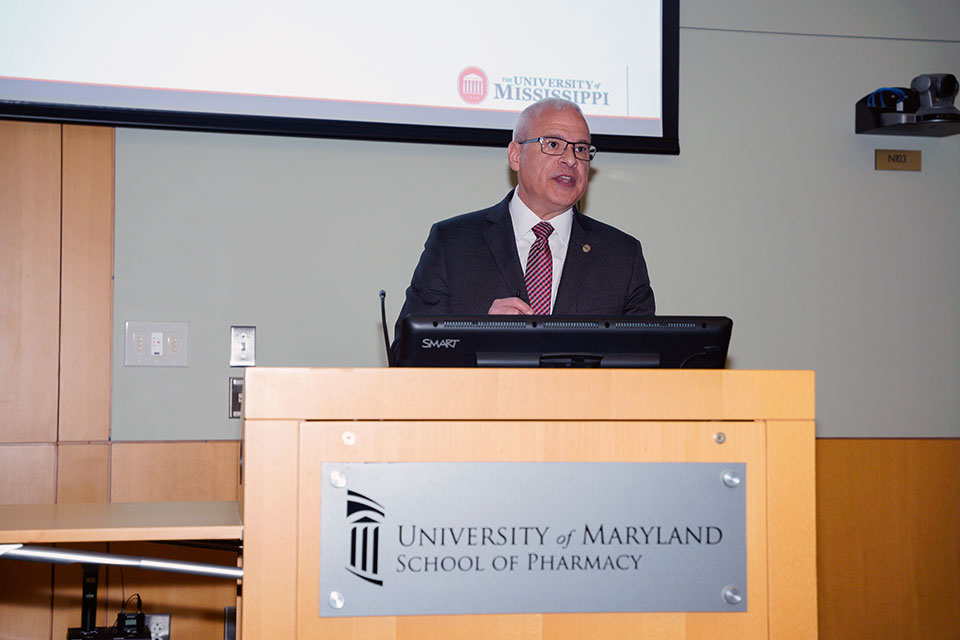
Double Alumnus Returns to UMSOP to Highlight the Imperative of Strategic Change in Higher Education During DuMez Memorial Lecture
May 12, 2025
Noel Wilkin posits that organizational transformation in higher education requires clear vision, emotional intelligence, strong leadership, and a shared commitment to progress.
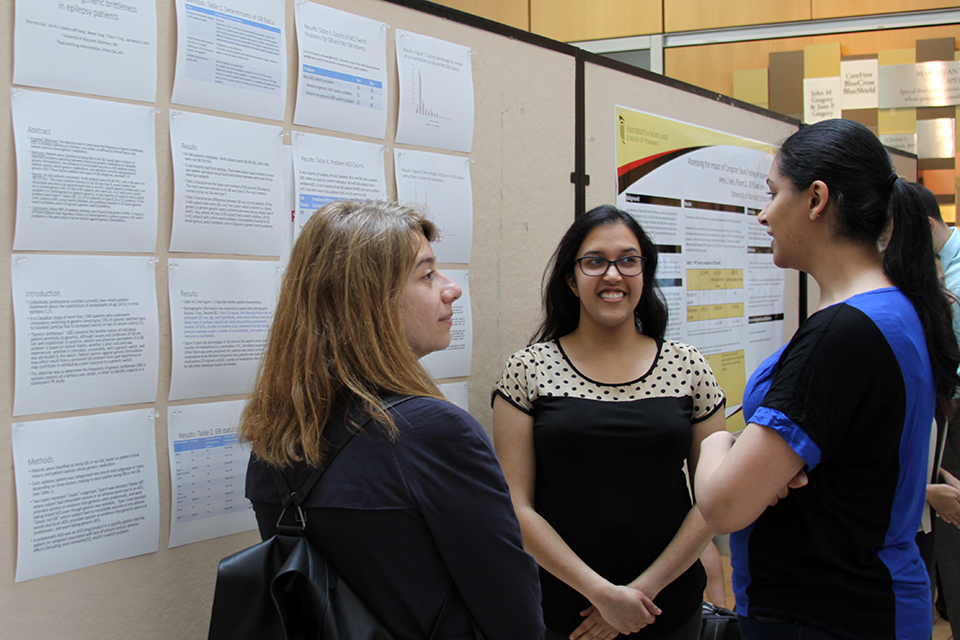
SOP’s Annual Research Day Showcases Students and Trainees’ Work
April 26, 2017
Day-long event featured the School’s annual Andrew G. DuMez Memorial Lecture and offered opportunities for participants to network with potential collaborators.