
PCORI Leader Highlights Path from Patient-Centered Research to Better Health Care
Harv Feldman, MD, shares funding opportunities and examples of comparative clinical effectiveness research during UMSOP lecture
By UMSOP Office of Communications and Marketing
October 7, 2026
For Harv Feldman, MD, the value of patient-centered research does not end when a study is published. The ultimate goal is to generate evidence that helps patients, caregivers, and health care professionals make informed decisions and then ensure that evidence reaches the people and health systems that can put it to use.
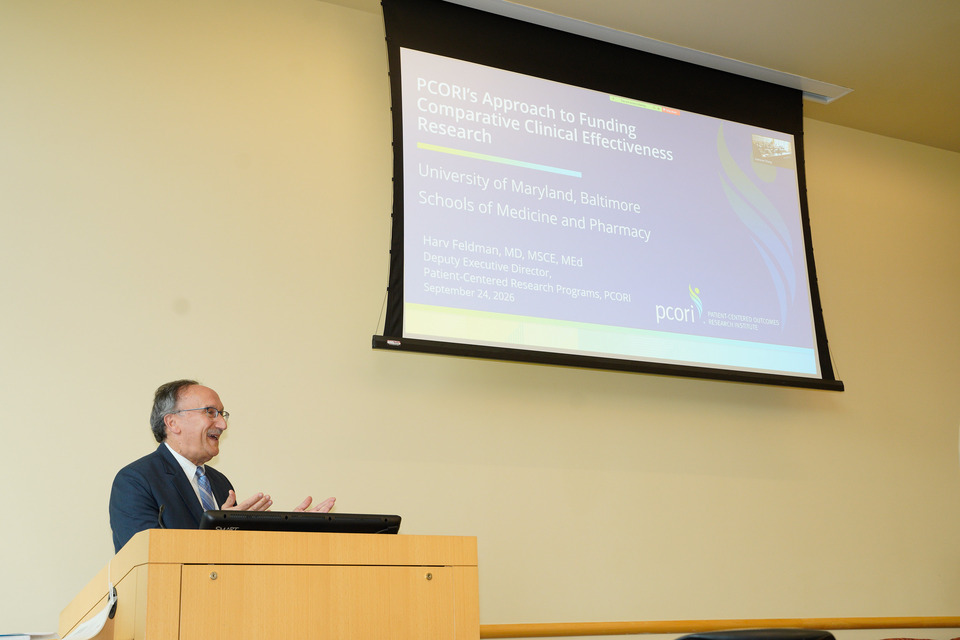
Feldman, deputy executive director for patient-centered research programs at the Patient-Centered Outcomes Research Institute (PCORI), presented “PCORI’s Approach to Funding Comparative Clinical Effectiveness Research,” a lecture hosted by the University of Maryland School of Pharmacy (UMSOP) on Sept. 24. His presentation explored PCORI’s approach to funding comparative clinical effectiveness research (CER), as well as opportunities in patient and community engagement and dissemination and implementation.
Sarah L. J. Michel, PhD, dean of UMSOP and professor of pharmaceutical sciences, welcomed Feldman and highlighted the longstanding partnership between PCORI and the University of Maryland, Baltimore.
“PCORI’s commitment to patient-centered research has helped shape important work across our institution, and we are deeply grateful for that partnership,” Michel said. “From helping advance the science of patient engagement to supporting pragmatic clinical trials and community-engaged research, PCORI has helped us bring research closer to the patients and communities we serve.”
UMSOP has partnered with PCORI since the organization’s earliest years. One of the School’s first PCORI-supported projects helped inform PCORI’s original Methodology Standards by identifying approaches for engaging hard-to-reach patient populations in research. PCORI subsequently supported collaborations between UMSOP and the University of Maryland School of Medicine, including pragmatic clinical trials examining infection prevention and blood clot prevention strategies for orthopedic trauma patients.
More recently, PCORI has supported research and engagement through UMSOP’s PATIENTS Program, including projects focused on community engagement and dissemination of research findings related to Parkinson’s disease and post-traumatic stress disorder.
From evidence to impact
Feldman described PCORI as one of the nation’s principal funders of CER, which compares two or more health care approaches that have existing evidence of effectiveness or are commonly used. The goal is to generate evidence about which approaches work best for different patients and circumstances.
Unlike traditional clinical research that may be conducted in highly controlled settings, PCORI places a strong emphasis on research conducted in real-world populations and on meaningful engagement with patients, caregivers and other stakeholders.
Feldman highlighted several PCORI-funded studies to demonstrate how that approach can produce evidence with practical implications.
One study examined the use of electronic patient-reported outcomes for people with metastatic cancer. Patients provided information about symptoms and well-being directly to their care teams, supplementing usual care. While the intervention did not improve survival, it produced meaningful improvements in quality of life and well-being and reduced emergency department use.
Another study compared pharmacist-led telehealth care with clinic-based care for people with severely uncontrolled hypertension. The study found that telehealth care was safe and effective, while offering patients an alternative to traveling to a clinic for care.
A third study examined hypertension treatment among children with kidney disease. Researchers found that one class of medications was associated with lower risks of dialysis or kidney transplantation, less major loss of kidney function, better blood pressure control and fewer adverse effects—findings that could help provide greater certainty for clinicians and families making treatment decisions.
Moving research into practice
Feldman also emphasized that generating evidence is only part of the process. PCORI increasingly supports dissemination and implementation efforts designed to help health systems put research findings into practice.
“If you learn something, but you can’t get it out there, and it’s not implementable outside of the environment where the evidence was generated, then it doesn’t have as much use,” Feldman said.
He described PCORI’s Health Systems Implementation Initiative, which works with dozens of health systems to implement findings from PCORI-funded CER studies. Projects have addressed issues including reducing unnecessary use of broad-spectrum antibiotics in children, supporting lifestyle treatment for weight loss in primary care, improving hypertension treatment and expanding the use of electronic patient-reported outcomes.
These efforts also allow PCORI and participating health systems to learn how evidence-based interventions can be adapted to different settings and populations.
Opportunities for researchers
Feldman encouraged UMSOP faculty and other researchers to become familiar with PCORI’s range of funding and engagement opportunities. PCORI offers broad funding opportunities for investigator-initiated ideas, as well as focused funding announcements addressing specific research priorities.
Its portfolio includes large pragmatic comparative effectiveness studies, methodology development, patient and community engagement, and dissemination and implementation projects. Researchers also can engage with PCORI through advisory panels, merit review, its ambassador program and other activities.
For UMSOP, the lecture provided an opportunity to build on an established relationship with an organization whose emphasis on patient-centered evidence aligns closely with the School’s commitment to improving health and health care.
“Those who are really doing the hard work of research and dissemination and implementation” need to understand the opportunities available through PCORI, Feldman said.
The Sept. 24 lecture was held in person and virtually and included a question-and-answer session with UMSOP faculty and other attendees.
Related News Stories

UMSOP Faculty Member to Lead New Study to Strengthen Community Voices in Research
January 12, 2026
The two-year study will help ensure patient and community perspectives are meaningfully included in research.
PATIENTS Program Grant Establishes Collaboration with Southwest Partnership in Baltimore City
August 25, 2021
Researchers and community members attend interactive training sessions together to discuss health care research and patient-centered outcomes
School of Pharmacy’s Lamy Center Works to Engage Older Adults and Caregivers through PCORI Engagement Award
August 19, 2021
Drs. Nicole Brandt and Catherine Cooke are leading efforts to create a network to support Patient-Centered Outcomes Research focusing on medication optimization.