
UMSOP’s Inaugural HiPitch Competition Highlights Importance of Communicating Research
In just three minutes, 14 student finalists presented their research or pharmapreneurial concept not as a technical exercise, but as a solution to a real health care problem.
By Emily Bleiweis
April 29, 2026
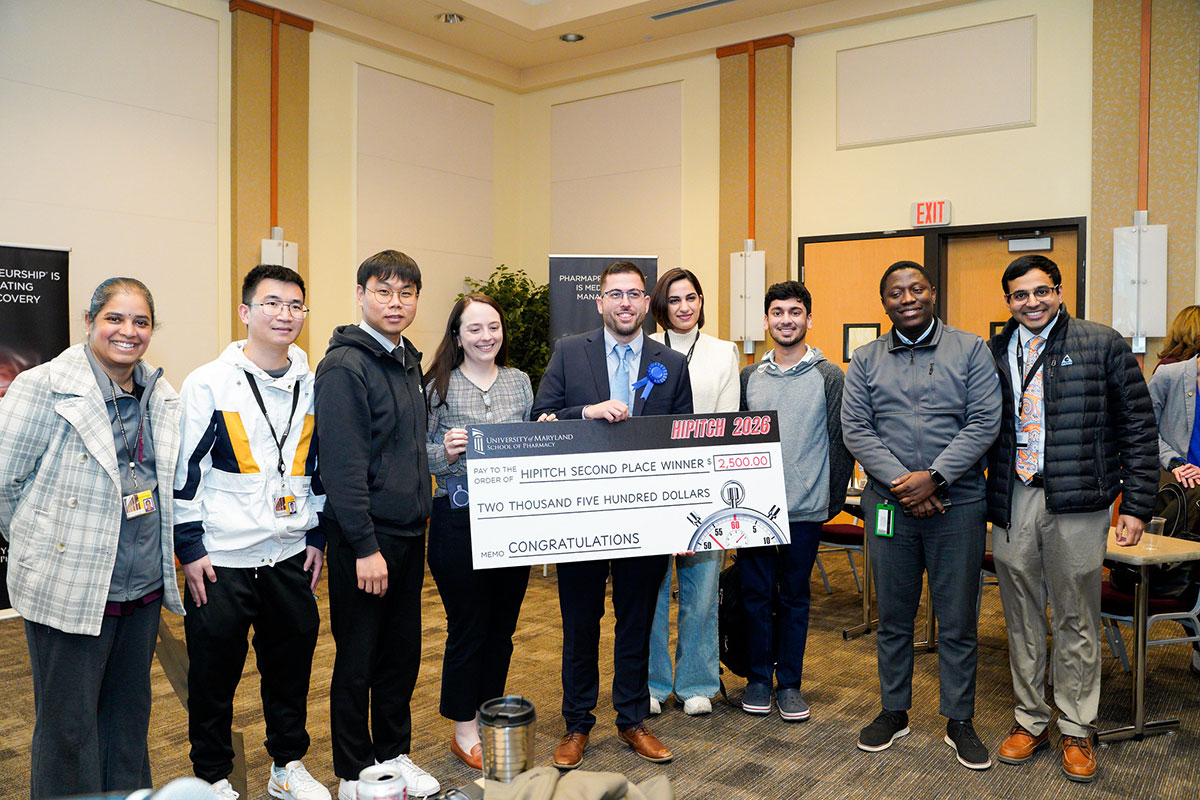
Photo: Athanasios Chamzas holds a HiPitch second‑place check while posing with members of the University of Maryland School of Pharmacy community at the HiPitch finals. View the full photo album on Flickr.
Imagine a world where routine prenatal ultrasounds could detect – and ultimately allow – medical professionals to improve or even prevent a birth defect before a child is born.
That was the concept behind Jeremie Piña’s winning idea, which he presented at the University of Maryland School of Pharmacy’s (UMSOP) 2026 HiPitch Competition held on April 8.
“Every three minutes, a child is born with a cleft lip or a cleft palate somewhere in the world,” Piña said in his pitch. “You can imagine the emotion that is carried with such a diagnosis when parents are so hopeful for this perfect human being to be born and enter their family.”
But what if instead of a future filled with surgeries, physicians could intervene before a cleft palate or lip is formed?
Piña, PhD, MBA, MS, a Doctor of Dental Surgery student at the University of Maryland School of Dentistry, presented the idea he and his collaborators have researched, which investigated the foundation of how faces form and found there’s a key network of signaling molecules.
“If we can optimize the signaling environment in a growing fetus in the womb, we can actually manipulate their growth environment to produce a normal facial structure,” he added.
HiPitch, a new element of UMSOP’s Pharmapreneureship initiative, was developed to help students like Piña better communicate their complex research and solutions that can often be challenging to explain. Unlike other pitching competitions, HiPitch’s goal is to help students not just understand how research is done but rather help them show why it matters through the lens of purpose, growth, and value.
The competition’s first year brought together 14 student finalists from across the Mid-Atlantic who each had three minutes to present their research or pharmapreneurial concept – not as a technical exercise, but as a solution to a real health care problem.
“Let me start with a simple question: How many ideas in health care never become reality? Not because they weren’t good, but because they were never challenged, shaped, or communicated well enough?,” asked Joga Gobburu, PhD, MBA, FCP, FAAPS, FISOP, UMSOP’s Gyi Endowed Memorial Professor in Pharmapreneurship and director of the Center for Translational Medicine, at the start of the event. “Pharmapreneurship exists to change that.”
HiPitch’s aim is to help participants step back and connect their work to the bigger picture, framing it under three main concepts: the problem it addresses, the decision it supports, and the impact it seeks to deliver. Each finalist was given three minutes to present their pitch live before an audience of faculty, staff, and collaborators, before taking two minutes of questions from judges.
Ideas ran the gamut, from developing apps to help college students with depression from social isolation to treating chronic pain through placebos.
A total of seven students won prizes, including:
- Piña’s first place win for his pitch, “From Birth to Adulthood — The Surgical Marathon,” which came with a $5,000 prize.
- Athanasios Chamzas, a PhD in pharmaceutical sciences student at UMSOP, earned second for his concept, “The Right Dose at the Right Time,” winning $2,500
- Four students placed third and won $1,000 each including:
- Ulysses Matricciani of Towson University for “Triagnostics: Spotting Remission is Our Mission”
- Luca Fornari of the University of Maryland School of Medicine (UMSOM) for “Prescribing Perception for Pain”
- Eunji Hong of Binghamton University for “The Silent Thief of Sight”
- Samuel Muma of the University of Maryland, College Park, for “Why Do We Wait”
- Sophie Ogunsanmi of UMSOM was the Audience Choice winner for “Climate Change: A Growing Health Risk,” also winning $1,000.
“HiPitch’s cross-institutional representation of really extraordinary ideas is exactly what innovation in health care demands,” said Sarah L.J. Michel, PhD, dean of UMSOP and professor of pharmaceutical sciences in opening remarks. “The core principles of the University of Maryland School of Pharmacy’s Pharmapreneurship initiative are purpose – meaning solving real and pressing health care problems; growth – building solutions that are sustainable and scalable; and value – your idea has to deliver solutions people want, use, and invest in.”
“HiPitch is essentially about taking a complex scientific or health care idea and communicating it in a way that resonates with diverse audiences, from clinicians and researchers to investors, policymakers, and patients,” she added.
In addition to the competition aspect, the event also included a keynote from Gevorg Grigoryan, PhD, co-founder and chief technology officer of Generate Biomedicines, Inc.
Grigoryan, a scientist-entrepreneur working at the intersection of machine learning, biology, and medicine, leads the development of generative biology platforms designed to create novel protein therapeutics across diverse disease areas.
He spoke of his journey through the academic world before moving into entrepreneurship, which he said was not his initial career goal.
“It’s strange to interpret my trajectory through the lens of having optimized for this outcome,” he said. “What I was rather always interested in is solving problems, and I’ve had a lot of passion for problems.”
In his keynote, Grigoryan also highlighted the importance of being able to adequately express research he’s working on.
“Ask yourself, ‘what do I have to tell them to be understood?’ And as long as you’re understood, that’s a 95 percent chance of success,” he said.
Piña was able to do just that in his presentation. The topic, while complicated, hit close to home for him, and he was able to explain it in a way that much of the room could relate to. Becoming emotional at the end of his presentation, he explained that his own child was born with a cardiac defect, found on a prenatal ultrasound.
And he wants to spend his life helping other families facing similar challenges.
“My ultimate goal is to be a surgeon that operates on these kids that are born with cleft lip and cleft palate,” Piña said after the competition ended. “I won first place, which just blows me away. I am feeling elated. I’m just so grateful to be here and for the support of the HiPitch community.”
“It was impressive to have students from across the region and beyond,” said Gobburu. “For HiPitch 2027, we will build on this year’s success and expand participation across the United States.”
Related News Stories
University of Maryland, Baltimore Partners with xFoundry Alliance to Expand Student Opportunities in Innovation
September 3, 2025
The University of Maryland, Baltimore (UMB) is building on its focus on innovative health care through a new partnership that will allow the university to advance its mission of improving the human condition.

UMSOP Announces Recipients of Two Prestigious Scholarships
July 9, 2025
The Gyi and Wagner Scholarships support student pharmacists interested in pharmapreneurship.

Leader in Pharmacometric Innovation and Drug Development Named Gyi Professor in Pharmapreneurship
May 8, 2025
Nationally and internationally recognized faculty member exemplifies the entrepreneurial spirit that defines pharmapreneurship.