
UMSOP Students Showcase Forward‑Thinking Solutions at America’s Got Regulatory Science Talent Competition
Students presented regulatory strategies that address emerging risks and enhance consumer safety in both traditional health care and rapidly expanding digital marketplaces.
By Pam Carder
February 10, 2026
View the photo album on Flickr.
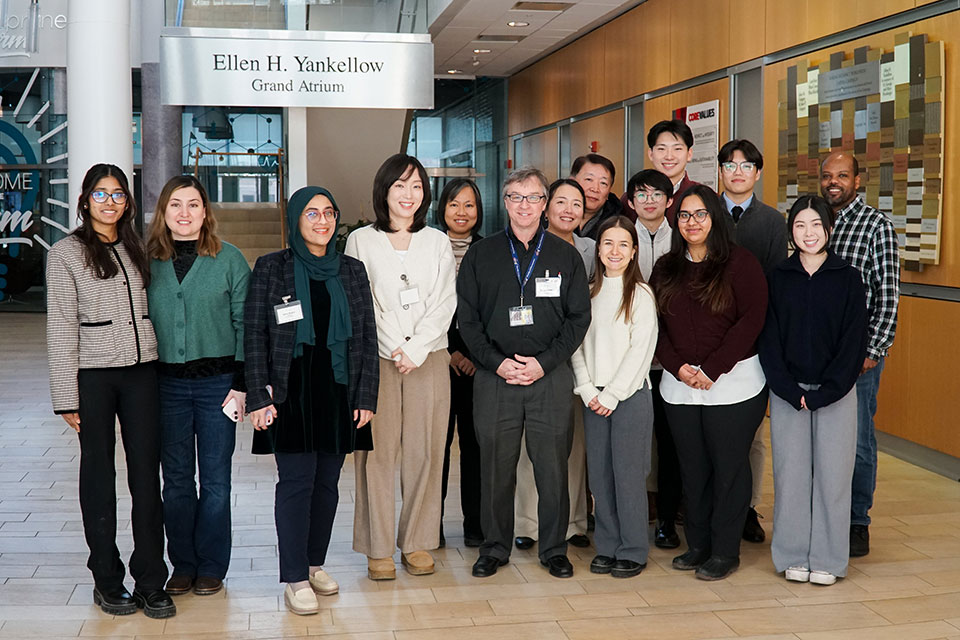
Students at the University of Maryland School of Pharmacy (UMSOP) presented innovative approaches to some of today’s complex regulatory challenges during the School’s annual America’s Got Regulatory Science Talent competition on Feb. 2 in Pharmacy Hall.
The event, hosted by Jim Polli, PhD, the Ralph F. Shangraw/Noxell Endowed Chair in Industrial Pharmacy and Pharmaceutics and director of UMSOP’s MS in Regulatory Science program, featured three student teams whose proposals addressed emerging issues in drug development, digital health communication, and oversight of compounded medications.
Polli praised the students’ commitment to tackling timely and consequential topics in regulatory science. “Each year, this competition brings current issues to the forefront in a way that is both practical and forward‑thinking,” he said. “Our students dedicate significant time and energy to developing solutions that not only demonstrate scientific rigor but also show real potential to strengthen public health.”
The competition invites pharmacy and regulatory science trainees to pitch concise, actionable ideas aligned with the U.S. Food and Drug Administration’s (FDA) mission. Each team delivered a five‑minute presentation before a panel of faculty judges.
Judges were Hongbing Wang, PhD, professor and interim chair of the Department of Pharmaceutical Sciences (PSC), and Berhanu Kibret, PhD, MS, BPharm, instructor of PSC.
Phase‑Out Animals
Members: Third-year student pharmacists Peiyun Pang (captain) and Quynh Pham
Team Phase‑Out Animals explored the scientific and regulatory implications of phasing out animal testing in drug development. Their presentation examined the promise of new approach methodologies (NAMs), including organ‑on‑chip technologies and in silico modeling, and identified where these alternatives can support, but not yet replace, traditional in vivo systems.
The team emphasized that while NAMs offer more human‑relevant data in early research, gaps remain in predicting long‑term immune responses, population‑level safety outcomes, and complex metabolism pathways, particularly for vaccines.
Rx Innovators
Members: Third-year student pharmacists Sarah Mughal (captain), Gianna Jun, Cherry Gomes, and Neshat Behboudi
Mentor: Kachikwu Illoh, MD, former medical officer, FDA
Team Rx Innovators focused on the booming presence of GLP‑1–related content on TikTok. They described how unregulated supplements and compounded GLP‑1 products frequently mimic the language and imagery of FDA‑approved medications, potentially misleading consumers.
Their proposal recommended an FDA‑managed digital health education overlay that would appear directly on TikTok videos containing GLP‑1‑related cues, offering plain‑language guidance without limiting user access or restricting content. The approach builds on patterns TikTok previously used to counter COVID‑19 misinformation.
Clear Path
Members: Third-year student pharmacists Nimrat Sangha (captain) and Klaudia Antoniak, and first-year student pharmacists Irene Kwak, Lance Wong, Kosta Magoulas, and Matthew Hou
Team Clear Path addressed the regulatory gray area in which many compounded GLP‑1 products currently exist, especially as online pharmacies and telehealth companies accelerate direct‑to‑consumer marketing.
Clear Path detailed substantial safety concerns with compounded GLP‑1 alternatives, including the use of salt forms that are not FDA‑approved active ingredients; increased dosing errors associated with multidose vials; and more than 1,150 adverse event reports tied to compounded GLP‑1s as of July 2025.
Their Continuous Regulatory Vigilance Framework proposed system‑wide improvements such as pharmacist‑verified online dispensing, expanded FDA education initiatives, and standardized reporting requirements to better track digital marketing and distribution trends.
“So many of these medications and many side effects are not even reported. A normal, regulated, and safe environment is preferred for public safety,” said Sangha.
Winners and Impact
The judges awarded first place to Clear Path, praising the team’s comprehensive, feasible plan to modernize oversight as digital access to GLP‑1 medications continues to evolve. Phase‑Out Animals placed second, followed by Rx Innovators.
Polli commended all teams for demonstrating a deep understanding of the challenges and opportunities shaping today’s regulatory environment. “Their creativity and professionalism show how ready our students are to contribute to real‑world regulatory science,” he said.
Looking Ahead
Teams may be invited to present their proposals to FDA scientists later this year, continuing UMSOP’s longstanding partnership with the agency and reinforcing the School’s commitment to training the next generation of regulatory science innovators.
Related News Stories
Impressive Ideas and Robust Research Showcased at America’s Got Regulatory Science Talent Competition
February 12, 2025
Six student teams presented issues, findings, and solutions in annual competition focused on promoting interest in regulatory science.
SOP Talent Competition Highlights Student Innovation in Regulatory Science
February 6, 2014
M-CERSI’s “America’s Got Regulatory Science Talent” judges award student first prize for new technology to combat worldwide counterfeit drug crisis.
Student Talent Competition Focuses on Improvements in Regulatory Science
February 5, 2013
“America’s Got Regulatory Science Talent” judges award student first prize for his guidelines to improve reporting of adverse medication events to the Food and Drug Administration.