
UMSOP Research Day Showcases Innovation, Collaboration, and Impact Across the Sciences
Annual event highlights research spanning drug development, patient care, and public health.
By Pam Carder
April 22, 2026
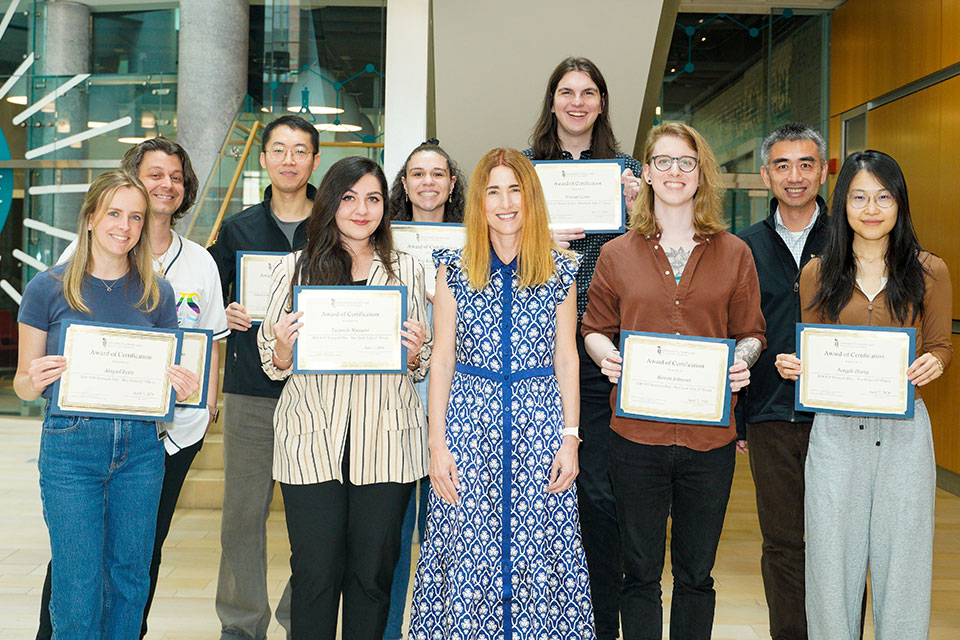
Left to right: Abigail Reitz, Guy Dayhoff II, Zijin Xu, Taraneh Mousavi, Kacey Vavaroutsos, Dean Sarah L.J. Michel, Vincent Lowe, Kieran Johnson, Fengtian Xue, and Fengdi Zhang.
The University of Maryland School of Pharmacy (UMSOP) brought together students, postdoctoral fellows, faculty, and colleagues from across the University of Maryland, Baltimore on April 7 for its annual Research Day, highlighting discoveries that span a full spectrum of science, from molecular research to population health.
See the Research Day photo album on Flickr
Advancing Research and Collaboration
The event opened with remarks from Sarah L.J. Michel, PhD, dean and professor of pharmaceutical sciences (PSC), who emphasized the importance of communicating science across disciplines.
“Research Day provides our trainees – whether they are students, residents, or postdoctoral fellows – with the opportunity to share their research with a wide audience and hone their communication skills,” she said.
Michel encouraged attendees to engage beyond their areas of expertise, underscoring the role of cross-disciplinary exchange in sparking new ideas.
A Snapshot of Research Impact
Research Day offered a snapshot of the School’s research, with projects reflecting both scientific rigor and real-world relevance. In the most recent reporting year, UMSOP investigators secured $36.1 million in sponsored research funding, ranking the School among the top 15 schools of pharmacy nationwide.
The work presented illustrated a broad and integrated approach to improving health, spanning drug discovery, clinical research, artificial intelligence applications, and studies focused on patient care and health policy.
Grollman Lecture Highlights Regulatory Science
The event also featured the Ellis S. Grollman Lecture in the Pharmaceutical Sciences, delivered by Steven Kozlowski, MD, chief scientist of the U.S. Food and Drug Administration. His talk, “Regulatory Science and Medical Product Development,” explored how regulatory science supports innovation while ensuring the safety and effectiveness of medical products.
Bringing Disciplines Together
Fengtian Xue, PhD, associate dean for research and professor of PSC, highlighted the importance of collaboration across fields.
“Research Day reflects who we are as a School,” Xue said. “It brings together students and scholars from across disciplines to share ideas, learn from one another, and see how their work fits into a bigger picture.”
He added that such interactions are essential to innovation, which often emerges at the intersection of different areas of expertise.
Outstanding Short Talks Recognized
Eight abstracts were selected for oral presentations, with awards recognizing the most outstanding short talks.
Best Short Talk Awards were presented to the following students:
- First place: Kieran Johnson (PhD in PSC)
- Second place: Vincent Lowe (PhD in PSC)
- Third place (tie): Taraneh Mousavi (PhD in Pharmaceutical Health Sciences Research [PHSR]), Sara Geriesh (PhD in PSC), and Jihyeon Lee, PhD in PSC)
Kieran Johnson, who earned first place, presented a novel approach to treating Pseudomonas aeruginosa, a drug-resistant bacterium that commonly causes hospital-acquired infections. His research explores compounds that disrupt the bacterium’s ability to sense and acquire iron, offering a potential new strategy when traditional antibiotics fall short.
Other presentations highlighted the growing role of data and technology in advancing research. Vincent Lowe demonstrated how integrating experimental data with machine learning can improve the speed and accuracy of identifying how drugs interact with proteins, a key step in drug development.
Several talks focused on public health challenges. Taraneh Mousavi used machine learning to identify how factors such as food insecurity and access to care are linked to higher rates of depression and opioid-related harms across U.S. communities. Yu-Hua Fu’s research found that only a small fraction of Medicare-Medicaid dual-eligible patients initiate medication treatment after an opioid use disorder diagnosis, underscoring persistent gaps in care.
At the molecular level, Sara Geriesh investigated why certain drugs cause liver injury, identifying inflammatory signals that may serve as early warning biomarkers. Jihyeon Lee developed computational tools to better target RNA – an emerging frontier in drug design that could expand treatment options for complex diseases.
Poster Sessions Highlight Breadth of Research
In total, 70 poster abstracts were submitted, spanning laboratory science, clinical research, health services, and policy.
Best Poster Awards were presented to the following students and fellows:
- First place: Ruoyi Zhang (PharmD)
- Second place (tie): Zijin Xu (PhD in PHSR) and Abigail Reitz (PhD in PSC)
- Third place (tie): Fengdi Zhang, ((PhD in PHSR), Guy Dayhoff II (postdoctoral fellow), and Kacey Vavaroutsos (PhD in PSC)
Ruoyi Zhang’s first-place project examined access to stem cell transplants for patients with multiple myeloma, identifying insurance type, age, and marital status as key factors influencing whether patients receive treatment.
Other projects focused on improving therapies. Zijin Xu is developing safer alternatives to an existing medication for alcohol use disorder by designing compounds that more selectively target a key enzyme while reducing side effects.
Abigail Reitz’s research explored how a naturally occurring chemical modification can alter the function of proteins involved in gene regulation during inflammation, pointing to a broader mechanism for how cells respond to stress.
Additional work highlighted the role of data and AI in pharmaceutical research. Guy Dayhoff II developed a machine learning platform to identify druggable targets across the human proteome, while Fengdi Zhang used large-scale health data to better understand how children with ADHD respond to medication.
Kacey Vavaroutsos evaluated in-home drug disposal products designed to reduce opioid misuse, with findings that may help inform FDA guidance and national prevention strategies.
An Opportunity to Grow as Scientists
“Research Day is a great training opportunity – not just for preparing for conferences, but for communicating science more broadly,” said Geriesh. “You’re presenting to people from many different disciplines, so you must explain your work in a way that anyone can understand. That can be more challenging than presenting at a conference, where most people already know the background – but it’s also what makes it such valuable practice.”
Faculty leaders emphasized that this kind of experience is central to trainee development.
“One of the most important aspects of Research Day is the opportunity it gives students and trainees to grow as scientists,” Xue said. “Presenting their work, answering questions, and engaging with researchers from other areas all help prepare them for the next stage of their careers.”
Related News Stories
Faculty’s Research Highlights Health Care Impact of Wildfire Smoke
August 3, 2026
2023 wildfire smoke cost Maryland more than $2 million in health care and productivity costs. Research shows what steps could be taken to reduce future impact.
New PHSR Study Reveals Strong Public Support for Reducing Health Inequality in the U.S.
December 1, 2025
Dr. Julia Slejko’s research reveals that Americans value fairness in health outcomes, emphasizing the importance of equity in health care decision-making.

Breakthroughs Can’t Wait: Breaking Down Barriers to Care for Older Adults
November 20, 2025
Dr. Nicole Brandt is working to deliver wellness services to older adults in senior housing to remove barriers such as transportation.