
Physician Shares Lessons from Thousands of Patients Treated with Medical Cannabis
Bonni Goldstein, MD, discusses individualized care, emerging research, and the importance of clinician education during the School of Pharmacy’s John Holaday Endowed Lecture
By Office of Communications and Marketing
October 9, 2026
For more than 18 years, Bonni Goldstein, MD, has treated thousands of patients using medical cannabis, learning along the way that there is rarely a one-size-fits-all approach to cannabinoid medicine.
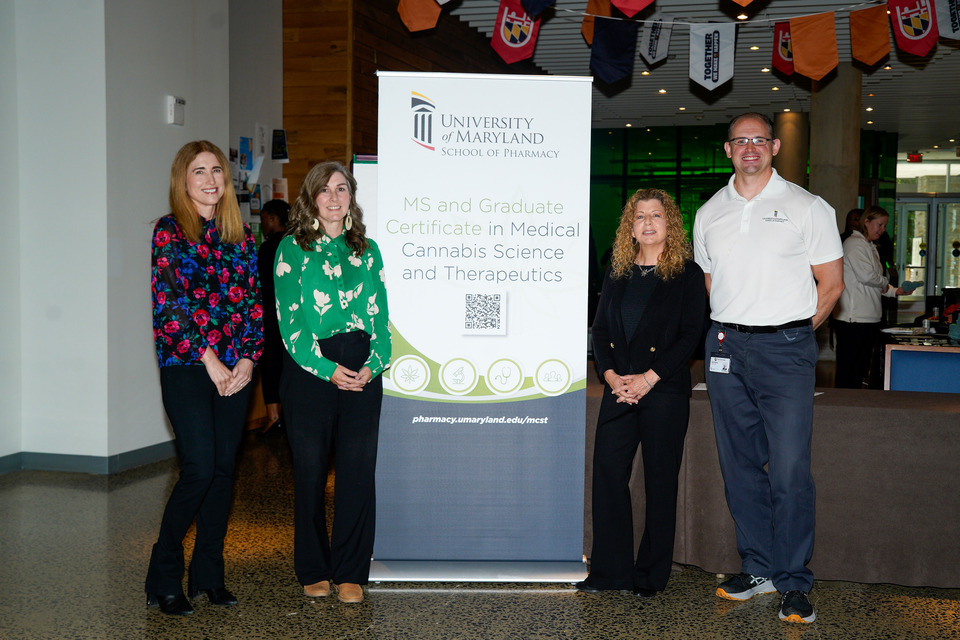
Goldstein shared those lessons with students, faculty, and guests at the University of Maryland School of Pharmacy’s John W. Holaday Endowed Memorial Lecture in Medical Cannabis on Sept. 25 at the Universities at Shady Grove. The lecture was part of the School’s fall symposium for students in the MS in Medical Cannabis Science and Therapeutics program.
“I left my practice of pediatric emergency medicine,” Goldstein said, explaining how she became interested in medical cannabis after a patient with cancer asked her questions she could not answer. She began studying the science of the endocannabinoid system and soon began seeing patients in a small practice in Long Beach, Calif.
“After about three months, I knew that this was going to be the rest of my life’s work,” she said.
Today, Goldstein is medical director of Canna-Centers Wellness & Education, a medical cannabis specialty practice in Los Angeles. She has a particular focus on children with intractable epilepsy, severe autism, cancer, and other refractory conditions. She also has co-authored research examining the use of pharmacometabolomics to better understand the effects of medical cannabis on behavioral symptoms associated with autism.
Understanding the endocannabinoid system
Goldstein began her lecture by explaining the endocannabinoid system, a regulatory network involved in maintaining balance, or homeostasis, throughout the body.
The system includes endocannabinoids produced naturally by the body, enzymes involved in their production and breakdown, and cannabinoid receptors. Goldstein emphasized that the system plays a role in regulating numerous physiological functions, including neurologic function, pain, sleep and stress, immune function and inflammation, metabolism, and gastrointestinal function.
For clinicians, understanding that system is essential to understanding why cannabinoids may affect multiple symptoms at once, she said.
Among the most common concerns she sees in her practice are chronic pain, anxiety, and insomnia, often occurring alongside other chronic conditions. Patients may initially seek treatment for one concern but ultimately report improvements across several areas.
Goldstein emphasized, however, that responses vary considerably from patient to patient.
“Some patients respond strongly, some only have partial response,” she said. “And some have no response.”
That variability makes individualized treatment and careful monitoring particularly important. Goldstein described a process of identifying a patient’s primary goals, selecting an appropriate cannabinoid and formulation, starting at a low dose, titrating slowly, and continually assessing benefits and adverse effects.
She encouraged future practitioners to make patient feedback an integral part of that process, including asking patients to keep detailed records of what they are taking, how much they are taking, and how they respond.
Evidence continues to evolve
Goldstein also addressed the growing body of research supporting medical cannabis while emphasizing the importance of distinguishing established evidence from emerging research and real-world clinical experience.
She highlighted research involving conditions including epilepsy, chronic pain, autism, and dementia. For pediatric epilepsy, she described how reports from families seeking alternatives for children with difficult-to-treat seizures helped spur research that eventually contributed to the development and regulatory approval of purified cannabidiol for certain forms of epilepsy.
Goldstein also discussed her own pharmacometabolomics research involving children with autism. In the study, researchers collected saliva samples before and after cannabis treatment and examined changes in hundreds of metabolites. Some of those changes correlated with behavioral improvements reported by the children’s parents.
The work represents an effort to move beyond anecdotal reports toward measurable biological evidence that may eventually help clinicians better predict which patients are likely to respond to particular cannabinoids.
“One of the things that would be really helpful with this is that once we can map out which metabolite changes in response to which cannabinoid, I can start targeting different cannabinoids,” Goldstein said. “So it just makes the trial and error a little less trial and error.”
Goldstein said much more research is needed, particularly as regulatory changes could create new opportunities for clinical investigation.
“We need more research, we need clinician education,” she told the audience. “We need medical access, and we need individualized care.”
Preparing the next generation
For students pursuing the MS in Medical Cannabis Science and Therapeutics, Goldstein’s presentation provided a firsthand look at the complexities involved in translating emerging science into patient care.
The John Holaday Lecture was established in 2020 through a gift from Curio Wellness in memory of the late John Holaday, a life sciences and biotechnology leader who served on Curio’s Scientific Advisory Board. Holaday was a scientist, entrepreneur, educator, and mentor who held more than 90 patents and authored more than 230 scientific articles. He also was deeply involved in efforts to address the opioid crisis.
For Goldstein, the opportunity to share her experience with students was also an opportunity to encourage them to approach medical cannabis as an evolving area of science and clinical practice – one that requires curiosity, careful observation, rigorous research, and a commitment to individualized patient care.
“We are smart enough to understand this plant,” Goldstein said. “We’re smart enough to understand the endocannabinoid system.”
Her message to the next generation of cannabis professionals was clear: the field still has significant questions to answer, but the opportunity to improve patient care through better research, education, and clinical practice is equally significant.
Related News Stories
Palliative Care Physician Gives John W. Holaday Endowed Memorial Lecture in Medical Cannabis
April 10, 2023
Dr. David Casarett discussed cannabis as potentially evidence-based medicine.