
University of Maryland School of Pharmacy Celebrates Class of 2026 MS and PhD Graduates
Students reflect on resilience, innovation, and leadership as they prepare to advance health care, science, and policy.
By Pam Carder
May 22, 2026
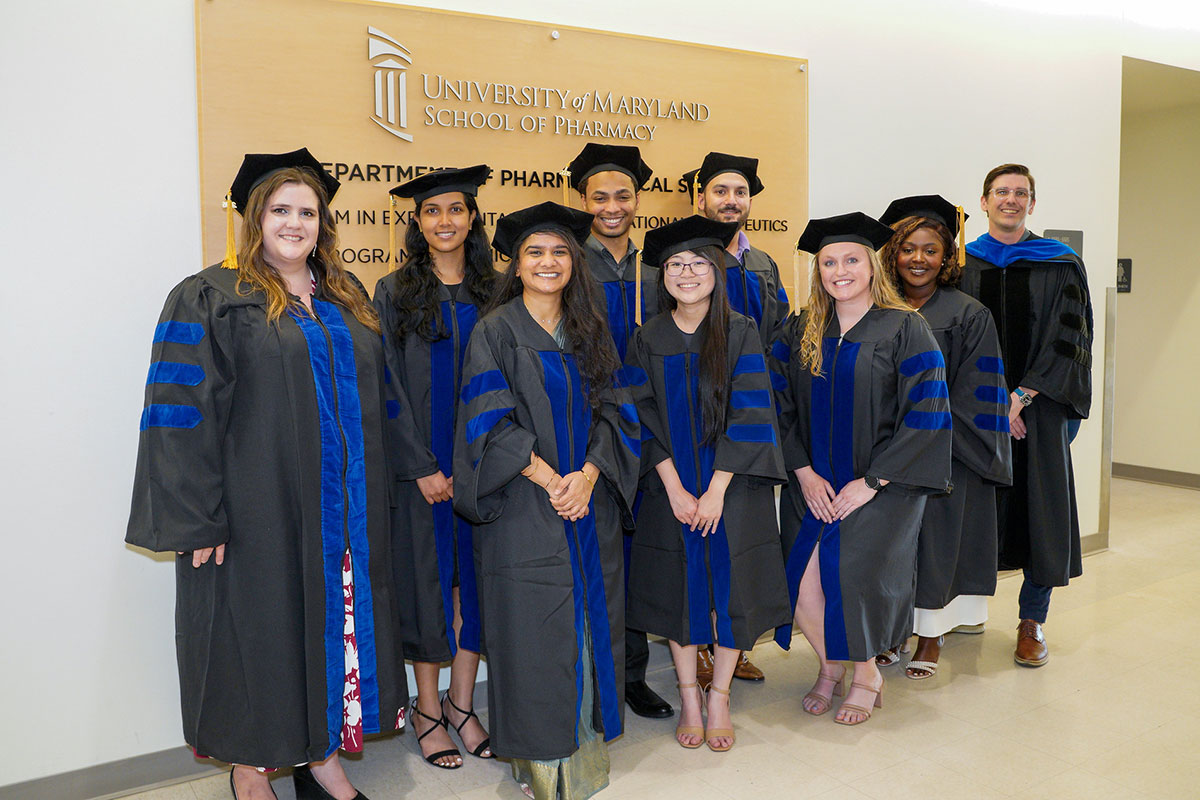
Graduates, faculty, family members, and friends gathered May 12–20 to celebrate the achievements of the University of Maryland School of Pharmacy (UMSOP) Class of 2026 during ceremonies across the School’s master’s, certificate, and doctoral programs.
Students from the Medical Cannabis Science and Therapeutics (MCST) program; the MS in Pharmaceutical Sciences (PSC) program; the MS and Certificate in Regulatory Science programs; the MS in Pharmacometrics program; the PhD in PSC program; and the PhD in Pharmaceutical Health Services Research (PHSR) program were recognized.
Across ceremonies, speakers highlighted the resilience and determination that carried graduates through rigorous training.
“Today is a celebration of hard work, persistence, sacrifice, and success,” said Sarah L.J. Michel, PhD, dean and professor of PSC, during remarks on May 20. “With the education you’ve earned, the relationships you’ve built, and the values you carry forward, there is no limit to what you can achieve.”
Medical Cannabis Science and Therapeutics Graduates Encouraged to Lead Through Change
The MCST program recognized 57 graduates during a May 12 ceremony at the Universities at Shady Grove in Rockville, Md., including 47 MS in MCST graduates and 10 from the MCST Certificate program.
“This year’s graduation is especially meaningful for us as a program,” said Chad Johnson, PhD, program director and assistant professor of PSC. “What began as a bold idea has become a sustained, growing academic community with alumni working across clinical care, industry, research, policy, education, and advocacy.”
Johnson highlighted the growing need for professionals with scientific and regulatory expertise amid recent changes in federal cannabis policy.
“Moments like this demand expertise – not speculation,” he said. “They demand professionals who understand pharmacology, product quality, patient safety, regulatory complexity, and ethical responsibility.”
Shanetha Marable-Lewis, MS ’22, executive director of Veterans Initiative 22, delivered the keynote address, urging graduates to embrace change and lead with resilience and integrity.
Drawing on her journey from foster care to earning a GED to becoming a graduate and leader in the field, she urged graduates to “improvise, adapt, and overcome.”
“You chose this path before it was the obvious choice,” Marable-Lewis said. “You’ve earned your expertise, and now, with every tool that life and this program has given you, it is time for you to lead.”
William “KC” Poynter Klens, MS ‘26, president of the Medical Cannabis Student Association, encouraged graduates to stay engaged in advancing research, education, and cannabis policy.
“There is no one way to incorporate this degree into your life,” Klens said. “Do not wait to plan that project, write that proposal, or pursue the idea that could help move the industry forward.”
View Flickr albums from the ceremonies and celebrations:
- Medical Cannabis Science and Therapeutics
- MS in Pharmaceutical Sciences and MS and Certificate in Regulatory Science
- PhD in Pharmaceutical Health Services Research Graduation Celebration
- PhD in Pharmaceutical Sciences Graduation Celebration
Pharmaceutical Sciences and Regulatory Science Graduates Prepare for the Future of Innovation
Graduates of the MS in Pharmaceutical Sciences (PSC) program and the MS and Graduate Certificate in Regulatory Science programs were recognized during May 20 convocation in Pharmacy Hall, including 35 MS in PSC graduates, 44 MS in Regulatory Science graduates, eight certificate graduates, and nine dual-degree PharmD/MS students.
Michel praised graduates for their resilience, professionalism, and commitment to advancing pharmaceutical and regulatory sciences.
“The need for experts like all of you has never been greater,” she said. “From understanding emerging diseases to developing life-saving therapies and vaccines to establishing standards that ensure safety, quality, and efficacy – your work will shape the future of health care and public health in profound ways.”
Elizabeth Miller, PharmD ’96, associate commissioner for the U.S. Food and Drug Administration’s Office of Inspections and Investigations, delivered the keynote address, highlighting the rapidly changing landscape of pharmaceutical innovation and regulation.
“You’re entering the profession in a time many are calling the second golden era of pharmaceutical innovation,” Miller said. “Scientific questions will grow more sophisticated, but integrity, humility, and a genuine commitment to serving patients will always matter.”
Student representatives from the Class of 2026 also reflected on their shared experiences of perseverance and growth.
Haley Vanessa Bonilla, MS ‘26, representing the MS in Regulatory Science program, emphasized the responsibility graduates now carry into the profession.
“Regardless of where we land, we carry a shared responsibility to ensure that progress in health care never comes at the cost of safety, ethics, or equity,” she said.
Hena Jignesh Shah, MS ‘26, speaking on behalf of the MS in PSC program, described the uncertainty and determination that shaped the cohort’s journey.
“This degree was not just classes and tests,” Shah said. “It was every uncertain day, every small win, and every moment where we failed over and over but still kept going. That is what we are celebrating today.”
Pharmacometrics Graduates Recognized for Advancing Quantitative and Data-Driven Science
Graduates of the MS in Pharmacometrics program were recognized during a May 16 online ceremony.
Bin Li, MS ‘26, reflected on how the program shaped his approach to clinical pharmacology and decision-making.
“The MS Pharmacometrics program has significantly strengthened my clinical pharmacology experience and, more importantly, trained me to think as an evidence-based, strategic decision-maker – not just a modeler,” he said.
Michael Singel, PharmD, MS ’26, described the program as a transformative experience that strengthened his skills in quantitative pharmacology and clinical application.
“As a clinical pharmacist, pursuing the MS in Pharmacometrics at the University of Maryland School of Pharmacy has been a transformative experience,” Singel said. “It strengthened my ability to apply quantitative pharmacology to patient care and therapeutic decision-making, as well as my skills in study design and protocol development. I was fortunate to learn from outstanding faculty, including Mathangi Gopalakrishnan, Allison Dunn, and Joga Gobburu, and to gain training in statistical analysis, coding, pharmacometric tools, and model development applied to real-world problems.”
PhD Graduates Reflect on Research, Discovery, and Impact
Graduates of the PhD in Pharmaceutical Sciences (PSC) and PhD in Pharmaceutical Health Services Research (PHSR) programs gathered May 20 for separate celebrations recognizing the completion of their doctoral studies prior to participating in the University of Maryland, Baltimore hooding ceremony. Ten students earned PhDs in PSC, and four completed the PhD in PHSR program.
Ryan Pearson, PhD, program director for the PhD in PSC program, highlighted the accomplishments of the graduating cohort and the strong mentorship supporting their success.
“This is one of the larger graduating classes we’ve celebrated in recent years,” Pearson said. “It speaks not only to the productivity and dedication of the students, but also to the strength of the faculty mentorship supporting them.”
Among the graduates recognized, Roshni Patel, PhD ‘26, recipient of the Dissertation of the Year Award, described how the program shaped both her scientific expertise and personal growth.
“This program helped me become not just a better scientist, but a better human being,” Patel said. “I’m a more confident scientist and a better person because of this experience.”
During the PHSR celebration, Yueh-Yi Chiang, PhD ‘26, reflected on the persistence and curiosity that guided her doctoral journey and encouraged fellow graduates to continue embracing new opportunities.
“Whenever I face challenges, I now ask myself, ‘Why not?’” Chiang said. “Research has no true limit because there are always new questions to ask and new methods to learn.”
Julia Slejko, PhD, program director of the Pharmaceutical Health Services Research graduate program and associate professor of practice, sciences, and health outcomes research, encouraged graduates to carry that spirit forward as they begin the next chapter of their careers.
“Embrace the unknown, and with confidence, continue to learn, innovate, and make a meaningful impact,” Slejko said.
Related News Stories
University of Maryland, Baltimore Celebrates Growing Class of Palliative Care Graduates
August 20, 2026
Class of 2026 brings together health professionals from across disciplines and around the world, including the program’s sixth PhD graduates
UMSOP Celebrates PharmD Class of 2026 at Convocation Ceremony
May 19, 2026
Graduates reflect on perseverance, leadership, and purpose as they prepare for careers across pharmacy practice, research, public health, and industry.
UMSOP Celebrates Nation’s First PhD Graduates in Palliative Care, Alongside MS and Certificate Recipients
August 13, 2025
Graduates poised to lead, innovate, and improve care for patients and families facing serious illness.