
UMSOP Hosts Francis S. Balassone Memorial Lecture on Pharmacist Full Practice Authority
Expanding pharmacists’ roles through independent authority and innovative regulatory frameworks can improve patient care and access.
By Pam Carder
December 9, 2025
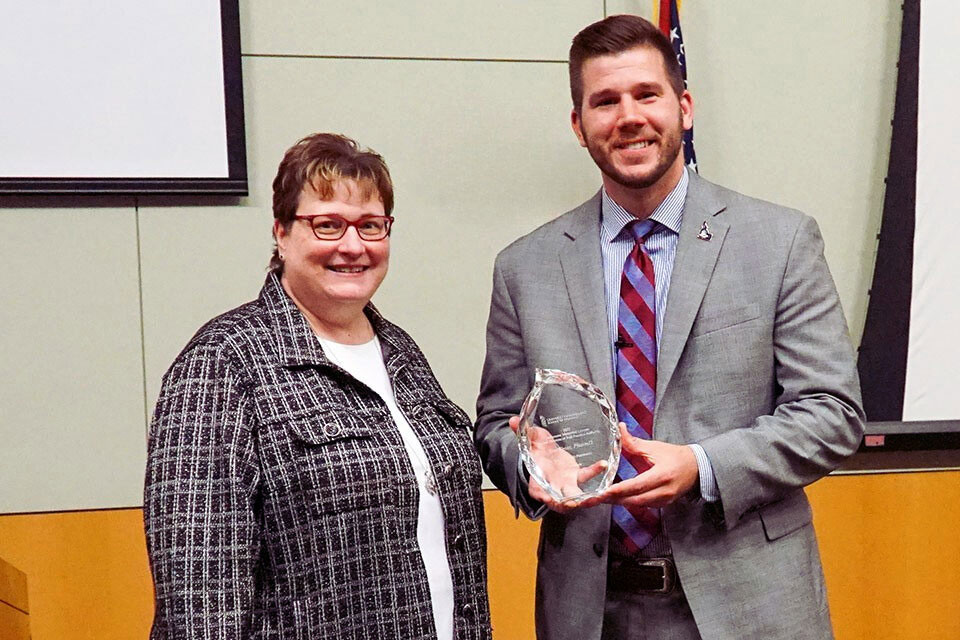
Image: Jill Morgan and Tim Frost
On Nov. 19, the University of Maryland School of Pharmacy welcomed Tim Frost, PharmD, as speaker for the Francis S. Balassone Memorial Lecture. Established in 1976 to honor alumnus and faculty member Francis S. Balassone, the lecture celebrates his legacy in pharmacy education and practice, including his role in creating the nation’s first school-based pharmacy student externship program.
Frost, a senior fellow at the Cicero Institute and founder of the health care strategy consultancy 50 Elixir, delivered a lecture titled “Toward Pharmacist Full Practice Authority.” Speaking to students, faculty, and staff, he highlighted the critical role pharmacists play in expanding patient access, improving care, and driving innovation in health care delivery.
Filling the Gap in Patient Access
Frost says that pharmacists are uniquely positioned to address gaps in care. “More than 30 percent of Americans don’t have a primary care provider, yet 90 percent live within five miles of a community pharmacy,” Frost explained. “With physician shortages projected to continue, pharmacists are uniquely positioned to step in, managing chronic conditions and minor ailments to fill gaps in care.”
He emphasized that pharmacists’ rigorous education – including four years of postgraduate study and more than 1,700 hours of clinical patient experience – prepares them to practice at the top of their profession. “Pharmacists have more standardized clinical training and patient care experience than many other health care professionals, yet overly prescriptive regulations create a ‘legal ceiling’ that limits our ability to fully leverage that training,” he said.
Standard of Care and Full Practice Authority
Frost emphasized two key reforms to modernize pharmacy practice: adopting a standard-of-care regulatory model and granting pharmacists full practice authority. “A standard-of-care model lets pharmacists rely on their professional judgment rather than rigid legal checklists,” he explained, while full practice authority would allow them to prescribe medications, administer drugs, and order or interpret lab tests independently.
He noted that states like Idaho, Alaska, and Iowa have successfully used these frameworks to streamline regulations without compromising patient safety.
Building Support and Overcoming Opposition
Frost stressed the importance of coalition-building and advocacy. “Insurers, hospital associations, pharmacy schools, and physician allies are supportive of expanded pharmacist roles,” he said. “Every pharmacist can help remove barriers, expand patient access, and ensure care is delivered at the highest level of expertise.”
Frost encouraged practitioners to engage with state boards of pharmacy, legislators, and local stakeholders, noting that “independent authority cannot be delegated; it must be implemented interprofessionally to truly address the health care access crisis.”
Looking Forward
Concluding his lecture, Frost urged pharmacy students and practitioners to take an active role in advocacy. “What service would you provide if the law were not standing in your way? Find that patient you want to serve, and take your seat at the table,” he said. “Our advocacy will continue to see states knock down barriers to drug administration, laboratory testing, and prescribing so pharmacists can practice at the top of their education and training.”
Reflecting on the lecture, Jill Morgan, PharmD, BCPS, BCPPS, FNAP, professor and chair of the Department of Practice, Sciences, and Health Outcomes Research, said, “We are grateful for Dr. Frost’s insights and perspective. His presentation challenges us to work with the legislators in Maryland to move this idea forward in Maryland thereby allowing pharmacists in the state to practice at the top of our their pharmacy licenses and expanding excellent patient care to the citizens of Maryland.”
Related News Stories

UMSOP Faculty Member Selected for Prestigious Elkins SoTL Fellowship
June 23, 2025
Fellowship project explores TILT strategies to improve pharmacy student readiness for experiential rotations.

Use of AI in Pharmacy Focus of Annual Balassone Memorial Lecture
December 19, 2024
The annual Balassone Memorial Lecture, held on Nov. 20, featured a panel of experts in discussion on the emerging role of generative AI in pharmacy and population health.
UMSOP Announces Formation of New Department of Practice, Sciences, and Health Outcomes Research (P-SHOR)
September 21, 2022
P-SHOR merges expertise of two existing departments.