
DEA Official Highlights Pharmacists’ Role in Preventing Drug Diversion at 2026 Paul Pumpian Memorial Lecture
Lecture explored emerging drug trends, public health challenges, and the evolving role of pharmacists in safeguarding communities.
By Pam Carder
June 8, 2026
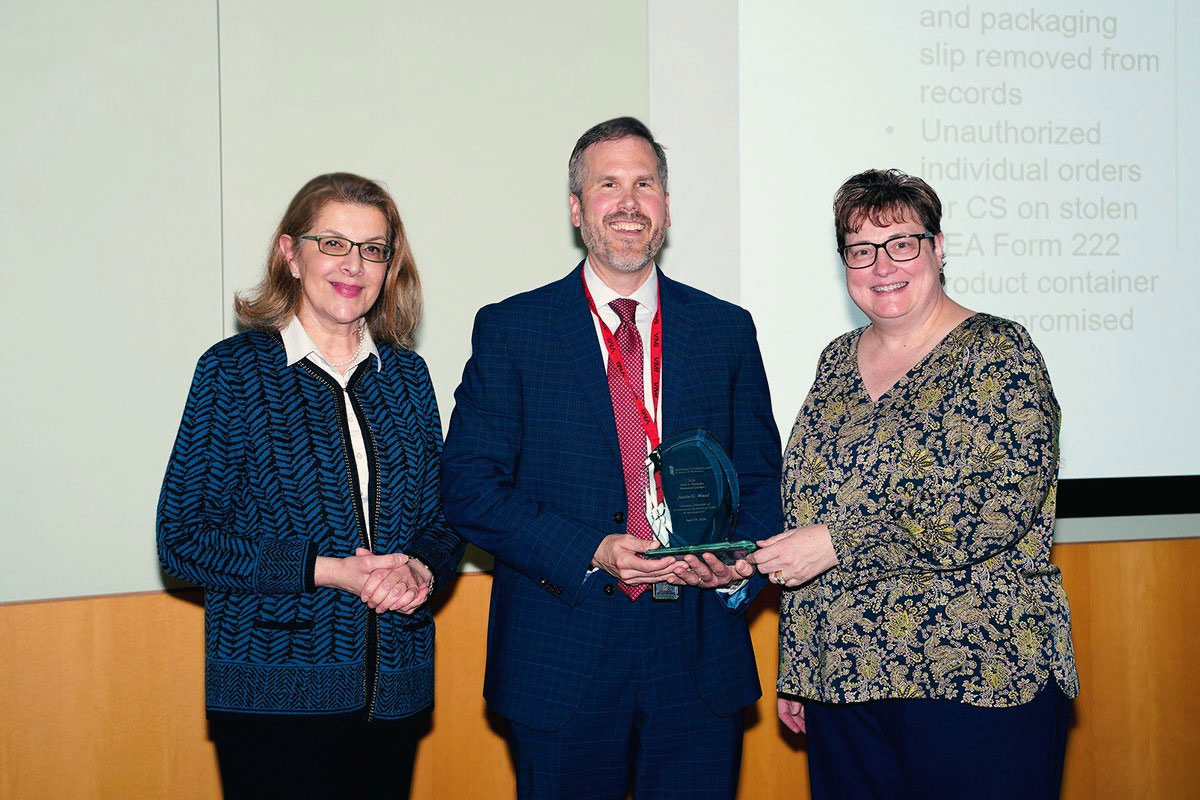
Photo: Fadia Shaya, Justin Wood, and Jill Morgan
Hundreds of faculty, staff, students, and guests gathered at the University of Maryland School of Pharmacy (UMSOP) on April 29 for the 2026 Paul A. Pumpian Memorial Lecture, featuring Justin Wood, diversion program manager for the U.S. Drug Enforcement Administration’s (DEA) Washington Division.
Wood’s lecture focused on drug diversion, illicit fentanyl, emerging drug trends, and the significant role pharmacists play in protecting patients and communities.
Introducing the speaker, Fadia Shaya, PhD, MPH, professor of practice, sciences, and health outcomes research at UMSOP, MPower Professor and Distinguished University Professor, reflected on the legacy of Paul Pumpian, whose career bridged pharmacy, law, regulation, and public service.
“This tradition brings to our community leading voices on issues that shape pharmacy practice, policy, and public health,” she said.
She also highlighted the importance of drug and health policy, citing the Health in All Policy (HiAP) framework and how stakeholder engagement is critical to the dissemination and implementation of best practices.
Understanding Today’s Drug Landscape
Drawing from more than 20 years of experience in diversion control and pharmaceutical investigations, Wood discussed how the nation’s drug landscape has evolved significantly over the course of his career.
“We at the DEA have a single mission, and that’s to enforce the federal controlled substances laws and regulations of the United States,” Wood said. “But the main reason we do that is to save and protect American lives.”
Wood explained that the DEA’s work extends beyond enforcement and includes regulation, monitoring, outreach, and education efforts with health care professionals and communities.
“Our main focus is protecting communities,” he said.
Throughout the lecture, Wood described how misuse of prescription opioids contributed to broader public health challenges involving heroin, fentanyl, and other synthetic substances.
He noted that illicit fentanyl remains the primary driver of overdose deaths, but the landscape is becoming increasingly unpredictable due to adulterants and new, ultra-potent synthetic compounds “Particularly dangerous are counterfeit pills, made to look like prescription opioids and can contain fentanyl or methamphetamine, such as oxycodone (Oxycontin®, Percocet®), hydrocodone (Vicodin®), alprazolam (Xanax®), and amphetamines (Adderall®). You can never trust your own eyes to know if a pill is real,” Wood said, sharing photographs during his presentation that illustrated how closely counterfeit pills can resemble legitimate pharmaceutical products.
Wood also discussed changing drug trends in the Washington, D.C., Maryland, and Virginia region, including continued concerns surrounding fentanyl, methamphetamine, cocaine, heroin, and diverted prescription medications.
Pharmacists as Preventionists and Safeguards in the Medication Supply Chain
A central theme of the lecture was the key role pharmacists play in preventing diversion and maintaining the integrity of the medication supply chain.
Wood detailed the DEA’s initiatives to protect the “closed system of distribution” that Congress established under the Controlled Substances Act. Within this closed system, all authorized handlers of controlled substances – such as manufacturers, distributors, physicians, pharmacies, and others – must be registered with the DEA (unless exempt) and adhere to stringent accounting standards for all transactions involving controlled substances.
“We want to safeguard the entire supply chain,” he said.
Speaking directly to student pharmacists in attendance, Wood emphasized pharmacists’ responsibility to recognize and question suspicious prescribing or dispensing activity.
“You have a corresponding responsibility as a pharmacist,” he said. “You often know more about those substances than the prescriber.”
Wood encouraged future pharmacists to remain vigilant and engaged in protecting their communities and collaborating with regulators and health care professionals to prevent misuse and diversion of controlled prescription drugs.
Technology, Research, and Emerging Challenges
Wood also discussed how technology and social media have changed the way illicit substances are distributed, particularly among younger populations.
“Many of our young adults are discovering and obtaining illicit substances through their phones and various social media applications,” he stated.
During the question-and-answer session, attendees discussed topics including emerging substances such as kratom and nitazenes, and the therapeutic potential of psychedelic compounds.
Responding to a question regarding research involving psilocybin and other psychedelics, Wood emphasized the importance of evidence-based scientific research and collaboration with the research community.
“There’s a lot of cutting-edge research going on in substances that we may not have understood,” Wood said. “We at the DEA are always going to support legitimate research.”
He concluded his lecture by sharing valuable resources for health care professionals and introducing the new DEA Fentanyl Free America initiative. This initiative represents a crucial advance in our battle against the threats posed by fentanyl, as it aims to disrupt the supply chain and decrease its availability.
“We encourage you to visit www.dea.gov/fentanylfree to learn more about this initiative and discover how you can contribute to educating and supporting your community’s efforts toward becoming fentanyl-free.”
Related News Stories
A Welcome Boost from the BHRT Program @UMSOP
September 16, 2025
The Behavioral Health Resources and Technical Assistance Program drives data and substance solutions.
Industry Trailblazer Inspires Future Pharmacists to Lead with Purpose at Annual Pumpian Lecture
May 22, 2025
Carlos Doti urges students to view pharmacy as a platform for advancing access, equity, and innovation in health care.
Pumpian Lecture Provides Data-Driven Rationale for Health Equity and DEI Initiatives
April 17, 2024
Dr. Randal D. Pinkett is an entrepreneur, author, and diversity, equity, and inclusion expert.