
Chanel Whittaker Receives Prestigious USM Elkins Professorship to Develop Equity-Centered Leadership Program
University System of Maryland professorship will support development of a new leadership program to prepare future health professionals to advance health equity.
By Office of Communications and Marketing
September 1, 2026
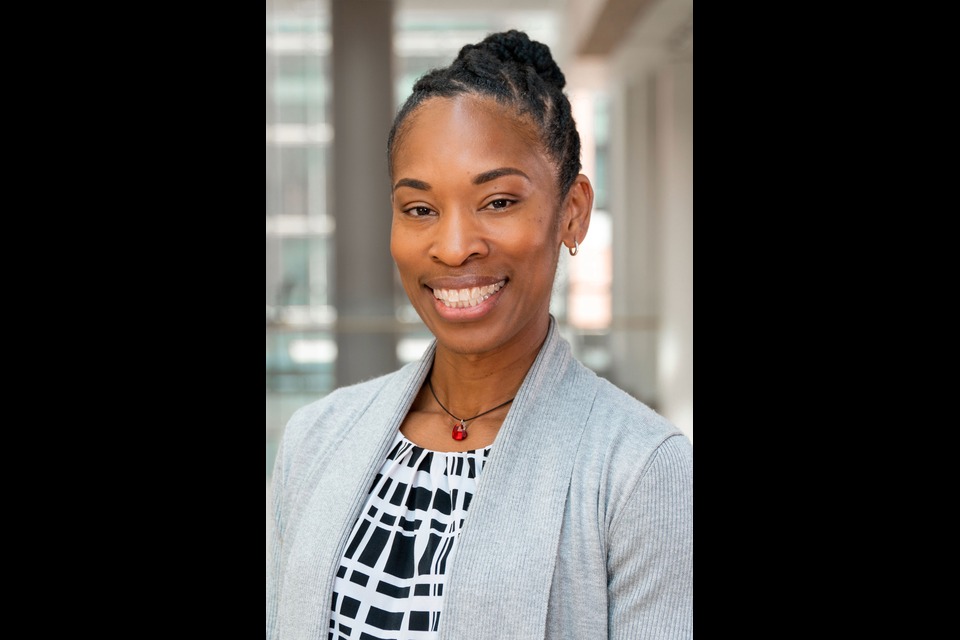
Chanel F. Whittaker, PharmD, BCGP, FASCP, CPDC, professor of practice, sciences, and health outcomes research and associate dean for institutional excellence and engagement at the University of Maryland School of Pharmacy, has been selected to receive a Wilson H. Elkins Traditional Professorship from the University System of Maryland (USM).
Whittaker is one of three faculty members across USM selected for the prestigious award this year. She will receive $40,000 to support her project, The Health Equity and Leadership (HEAL) Fellowship: Preparing Future-Ready Health Care Leaders Through Equity-Centered Leadership Development, an innovative model designed to prepare PharmD students and other future health professionals to lead change through an equity-centered lens.
“Preparing future-ready health care leaders requires more than teaching students how to lead themselves, work with others, or manage within existing systems,” Whittaker says. “They must also develop an equity lens, adaptability, and the ability to share power and lead collaboratively across diverse teams and communities.”
Preparing leaders to transform health care
Traditional health professions leadership education often focuses on communication, teamwork, self-leadership, and clinical or systems management. Whittaker’s proposal argues that emerging health care leaders also need the skills to understand and address the broader institutional, social, and community factors that influence health outcomes.
The HEAL Fellowship will bring those elements together through four interconnected areas of leadership development: equity-minded leadership; shared and participatory leadership; systems thinking and organizational change; and community-engaged leadership.
The framework will provide students with practical opportunities to apply these competencies. Students may participate in bystander training and reflective exercises, practice restorative and dialogic approaches to communication and conflict, engage in team-based simulations focused on organizational challenges, and participate in mentored leadership experiences through the School’s Inclusive Excellence Council.
Students will learn about the historical, social, and structural context of the communities surrounding UMB and participate in experiences designed to develop authentic, reciprocal partnerships with community organizations. Planned activities include a West Baltimore community orientation and a place-based learning experience connecting Baltimore’s history with present-day health outcomes.
“Rather than approaching community engagement as an episodic service or outreach, students will learn how to build reciprocal, collaborative relationships necessary for sustainable impact,” Whittaker wrote.
Building on M-PACT
The HEAL Fellowship will build on the School of Pharmacy’s ongoing transformation of its Doctor of Pharmacy (PharmD) curriculum through M-PACT, which launched with the Fall 2026 semester.
M-PACT is designed to prepare student pharmacists for an increasingly complex health care landscape, with an emphasis on critical thinking, problem solving, structural humility, and health equity competencies. Whittaker’s HEAL framework will complement that work by giving students opportunities to develop and practice leadership skills in the context of those competencies.
Year one of the Elkins-supported project will focus on developing the HEAL framework, building partnerships, establishing infrastructure, assessing feasibility, and piloting educational activities. The goal is to refine the framework and prepare for formal integration in the M-Pact curriculum in Spring 2028. Recruitment for the inaugural cohort of HEAL Fellows from UMSOP’s PharmD program will begin in fall 2027.
Among the planned activities are development of HEAL modules for the Management and Leadership Essentials course, creation of team-based leadership simulations, development of assessment tools, and exploration of a formal fellowship completion and recognition pathway for students.
The project will also leverage expertise and infrastructure across UMB, including collaboration with UMB’s Office of Institutional Excellence and Institutional Effectiveness and Office of Community Engagement, as well as faculty and community partners with expertise in equity-centered leadership, organizational change, restorative practices, and community-engaged scholarship.
From individual leadership to systems change
For Whittaker, the HEAL Fellowship represents the next evolution of a career focused on health equity, education, mentorship, and organizational transformation.
As a clinical pharmacist, she established pharmacist-led ambulatory clinics and developed medication-use systems for older adults with cognitive impairment. As a residency program director and preceptor, she mentored emerging leaders who went on to establish new practice sites, assume leadership positions, and pursue national service initiatives. In her current role as associate dean at UMSOP, her work has expanded to organizational transformation and educational innovation.
Among her accomplishments, Whittaker led development of the School’s first inclusive excellence strategic plan, which advances health equity through shared leadership and supports the success and full potential of faculty, staff, and students.
“The HEAL Fellowship represents the integration and evolution of my clinical, scholarly, educational, and organizational leadership work,” Whittaker says.
The model is intentionally designed to extend beyond the School of Pharmacy. Although it will initially be piloted within pharmacy education, Whittaker envisions a flexible framework that could be adapted by other health professions programs to their own institutional settings, disciplines, resources, learners, and community partnerships.
“The long-term vision of the fellowship is to create a pathway for developing leaders who not only hold a bold vision for advancing health equity, but who are also able to articulate that vision through the everyday work of leadership,” Whittaker wrote.
The Elkins Professorship will provide protected faculty time and resources for instructional design, leadership development consultation, pilot educational activities, and dissemination of findings as Whittaker develops and tests the HEAL Fellowship.