
Balassone Lecture Features Pharmacy Education Leader and School of Pharmacy Alumna Wanda Maldonado Dávila
University of Puerto Rico School of Pharmacy dean shares lessons from more than two decades of developing and implementing a competency-based Doctor of Pharmacy curriculum as UMSOP launches its new M-Pact program.
By Office of Communications and Marketing
October 15, 2026
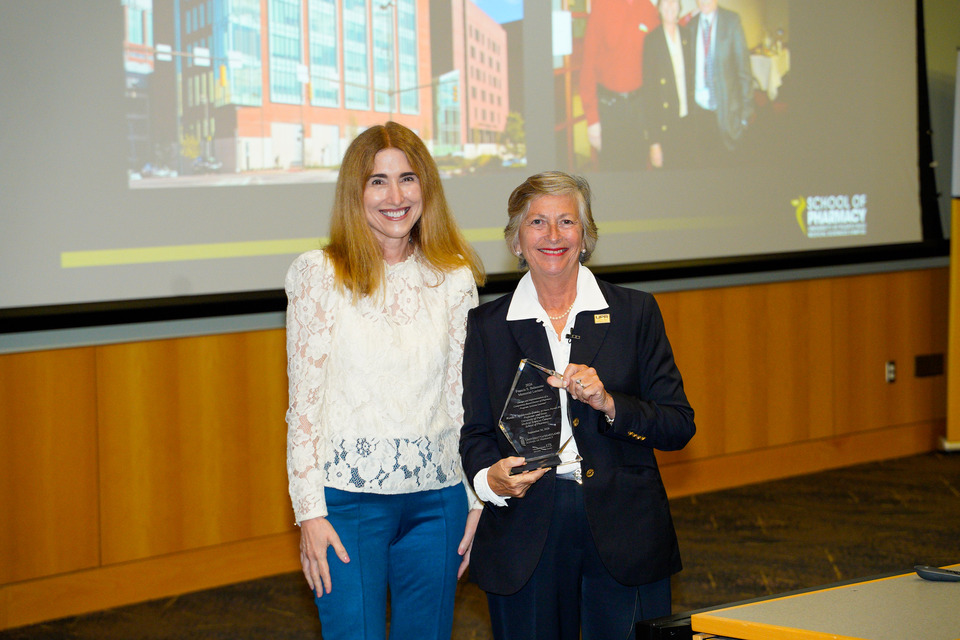
The University of Maryland School of Pharmacy (UMSOP) welcomed back alumna Wanda T. Maldonado Dávila, BSP ‘82, PharmD ‘86, FNAP, dean and professor at the University of Puerto Rico School of Pharmacy, for the annual Francis S. Balassone Memorial Lecture on Sept. 30. Maldonado shared lessons from more than 20 years of designing, implementing, and refining a competency-based Doctor of Pharmacy (PharmD) curriculum, offering insights for the UMSOP community embarking on its own curricular transformation.
Her lecture, “Design and Implementation of a Competency-Based Doctor of Pharmacy Program: Lessons Learned,” explored how the University of Puerto Rico developed its entry-level PharmD program, which welcomed its first students in 2001, and how sustained faculty engagement, intentional curriculum design, and ongoing assessment have helped support its implementation.
“Developing a new curriculum is one thing; implementing it, evaluating it, and continuing to refine it over time is another,” said Sarah L.J. Michel, PhD, dean of UMSOP and professor of pharmaceutical sciences, in her introduction of Maldonado. “That is why we are especially interested in hearing from someone who has been through this process and can share what she has learned along the way.”
The lecture was particularly timely for the School, which welcomed its first class of students into M-Pact, its reimagined PharmD curriculum, in fall 2026. Like the University of Puerto Rico’s program, M-Pact reflects the School’s commitment to preparing future-ready graduates with the knowledge, skills, and experiences needed to thrive in a changing pharmacy profession.
Building a curriculum around competencies
Maldonado Dávila traced the development of the University of Puerto Rico’s competency-based curriculum to faculty development efforts that began in the late 1980s. Those efforts included workshops on critical thinking skills, proposals for course redesign, and a grant from the American Association of Colleges of Pharmacy that supported faculty development and curricular changes between 1993 and 1995. The school designed its entry-level PharmD program in 1996 and implemented it in 2001.
A central lesson from that experience, Maldonado Dávila explained, was the faculty development and curriculum development needed to advance the curriculum redesign together. Preparing faculty to rethink teaching, learning, and assessment helped establish a foundation for broader curricular change.
The current PharmD program organizes student learning around 10 abilities, or competencies, that integrate conceptual knowledge, intellectual and professional skills, attitudes, and values. These abilities include pharmaceutical care, critical thinking, problem-solving and decision-making, ethics, communication, social interaction, social responsibility, and self-learning and professional development.
Rather than treating these competencies as isolated learning objectives, the curriculum connects them to the scientific foundations of pharmacy, professional practice, and patient care, as well as the social and cultural contexts in which pharmacists work. External professional frameworks inform the program, but its competencies are contextualized to the institution’s mission and the needs of its communities.
Students develop these abilities across three progressive levels, moving from establishing conceptual foundations to integrating knowledge across disciplines and ultimately demonstrating professional judgment and accountability. The approach emphasizes not only what students know, but also how they apply that knowledge and take responsibility for their decisions.
Connecting classroom learning to professional practice
Maldonado Dávila also described the structures that help translate the curriculum’s goals into students’ day-to-day learning experiences. At the University of Puerto Rico, six integrative seminars spanning the first three years of the PharmD program connect concepts across courses, contextualize competencies through pharmaceutical care, and help students document their development.
Course design plays an equally important role. Faculty align course objectives, learning activities, and assessment methods with the competencies students are expected to develop. For example, coursework in anti-infective agents integrates medicinal chemistry, pharmacology, biopharmaceutics, and pharmacokinetics to help students apply scientific knowledge to therapeutic problem-solving.
Student portfolios provide another mechanism for assessing progress. Through selected work, reflection, faculty feedback, and growth planning, students assemble evidence of their developing knowledge, skills, and professional judgment. The portfolios also help faculty evaluate student development and identify opportunities to improve the curriculum.
Together, these elements create a framework in which learning experiences, assessment, and professional expectations reinforce one another.
Lessons for the next generation of pharmacists
Reflecting on the University of Puerto Rico’s experience, Maldonado Dávila emphasized five lessons: invest in faculty development before redesigning a curriculum; adapt external frameworks to institutional missions and community needs; establish clear expectations for student development; build longitudinal experiences that integrate courses and learning opportunities across the curriculum; and use aligned evidence to support reflection, feedback, and continuous improvement.
She also underscored that competency-based education is not simply a matter of creating a curriculum map. It requires sustained alignment among institutional mission, faculty development, program competencies, course design, learning experiences, and authentic assessment—and a willingness to continue adapting as the profession and its communities change.
For the University of Maryland School of Pharmacy, those lessons offer a valuable perspective as faculty implement M-Pact and learn from its early stages.
“Dr. Maldonado Dávila’s experience in conceiving and implementing this program makes today’s lecture particularly timely for us,” Michel said. “I know our faculty and students will benefit from her experience, not only from what worked, but from the lessons that come from taking a new approach to educating future pharmacists and sustaining it over time.”
A homecoming for a pharmacy education leader
Maldonado Dávila’s return to Pharmacy Hall also highlighted the lasting connections between the School and its alumni. She earned both her Bachelor of Science in Pharmacy in 1982 and her Doctor of Pharmacy degree in 1986 from the University of Maryland School of Pharmacy.
After returning to Puerto Rico, she joined the University of Puerto Rico School of Pharmacy as a clinical faculty member and later served as chair of its Department of Pharmacy Practice. She has been dean and professor since 2010, leading efforts to advance pharmacy education and prepare future pharmacists.
Her leadership extends beyond her institution. Maldonado Dávila has held several leadership positions with the American Association of Colleges of Pharmacy, including chair of its Council of Deans and service on its Board of Directors. She has advocated for expanded pharmacist immunization services in Puerto Rico and served on the territory’s COVID-19 Medical Task Force in 2020. Her international work includes collaborations in pharmacy education throughout Central and South America and with the Pan American Health Organization and the International Pharmaceutical Federation. She currently serves as president of the Iberoamerican Conference of Faculties of Pharmacy.
Established in 1976 by the Maryland Pharmacists Association and the School’s Alumni Association, the Francis S. Balassone Memorial Lecture honors the legacy of a School alumnus who helped advance pharmacy practice and education. Balassone graduated from the School in 1940, taught at the institution, operated Overlea Pharmacy, and served for nearly two decades as commissioner and secretary-treasurer of the Maryland Board of Pharmacy.
Michel noted that Balassone’s commitment to moving the profession forward made Maldonado Dávila a fitting speaker for the annual lecture.
Related News Stories
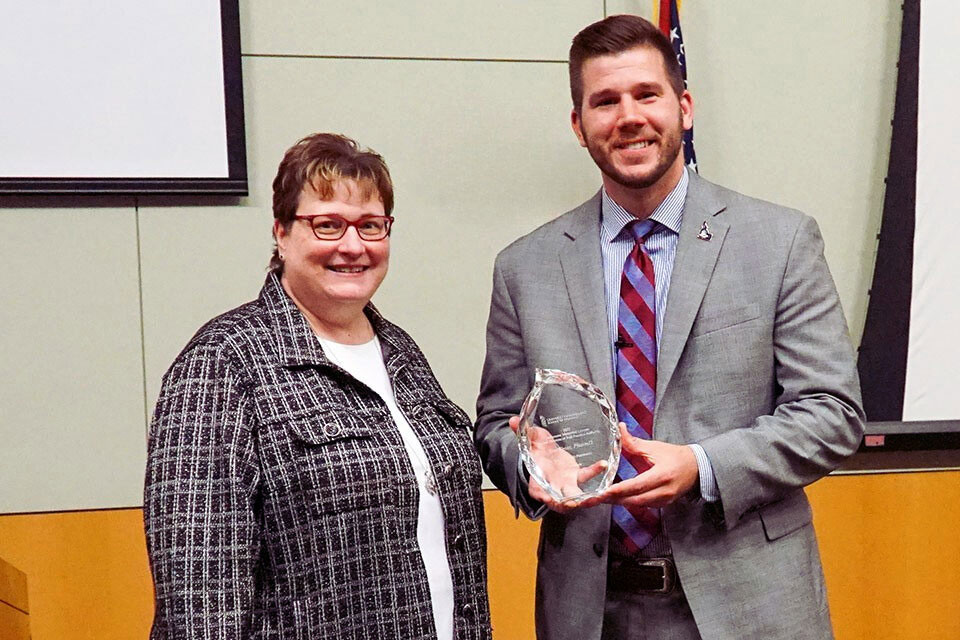
UMSOP Hosts Francis S. Balassone Memorial Lecture on Pharmacist Full Practice Authority
December 9, 2025
Expanding pharmacists’ roles through independent authority and innovative regulatory frameworks can improve patient care and access.
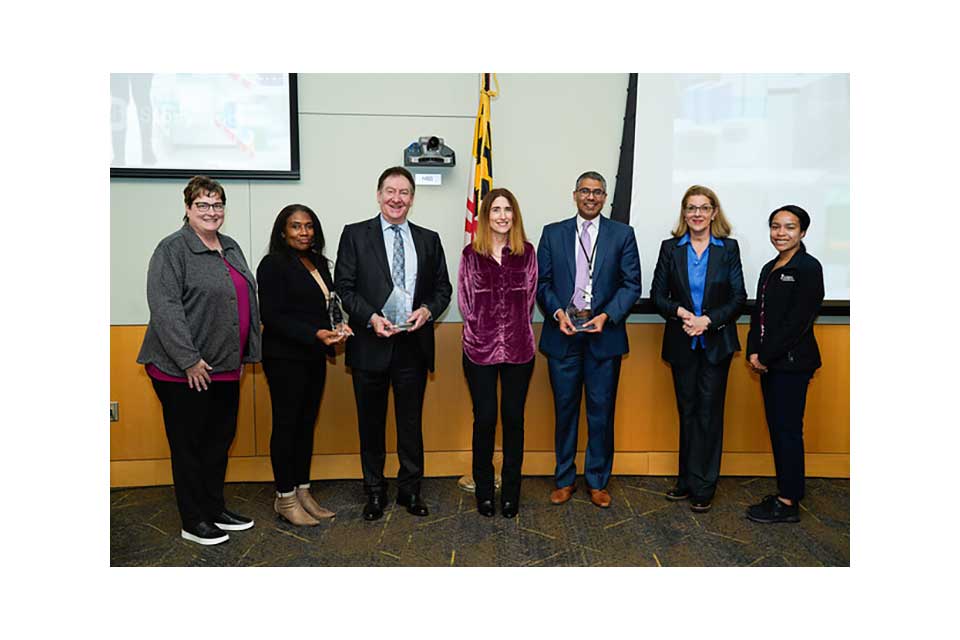
Use of AI in Pharmacy Focus of Annual Balassone Memorial Lecture
December 19, 2024
The annual Balassone Memorial Lecture, held on Nov. 20, featured a panel of experts in discussion on the emerging role of generative AI in pharmacy and population health.
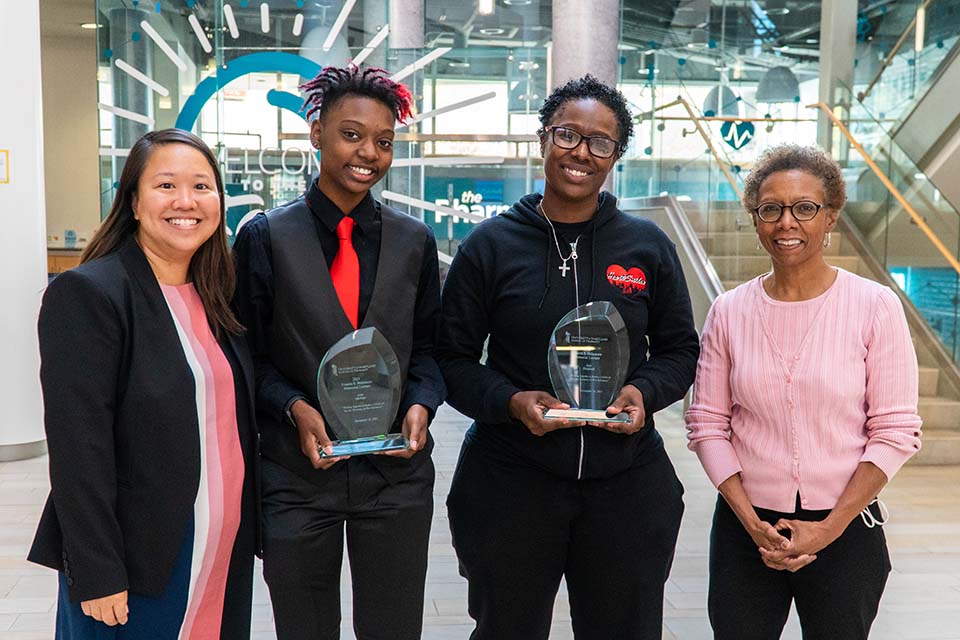
Balassone Memorial Lecture Focuses on COVID-19 Vaccine Hesitancy
November 23, 2021
Documentary showing and panel discussion with community activists are highlight of annual endowed lecture